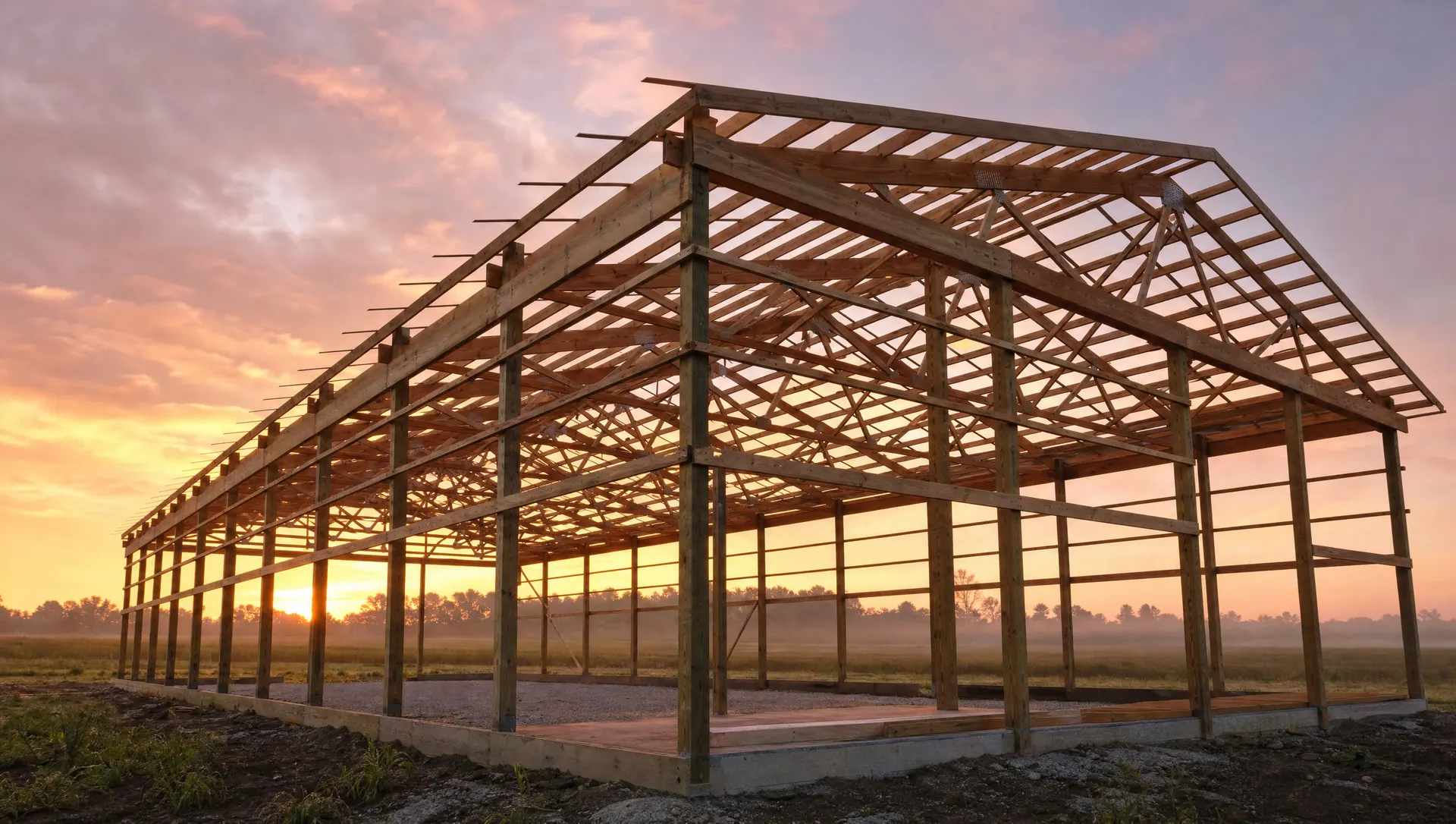
Pole Barn Construction in Boonville, MO
A pole barn gets talked about like it's one specific thing, when really it's a construction method that can become almost any building you need. Post-frame construction — the technical name for what most people just call a pole barn — is how we build general-purpose structures around Boonville: machine sheds, general storage buildings, combination shop-and-storage buildings, and everything in between that doesn't fit neatly into "barn" or "garage" or "shop."
What's Included in a Pole Barn Construction Project
Every project starts with the basics: post layout and depth engineered for the building's size and use, a structural frame, trusses, metal roofing, and metal siding. From there, the project takes shape around what you actually need:
- Door openings sized for what has to go through them — walk doors, sliding doors, overhead doors for vehicles and equipment
- Wall height and roof pitch that match the building's purpose, from a low-profile storage shed to a tall shop that needs to clear a lift
- Optional features like windows, insulation, wainscot, and concrete, added based on how the building will be used
- Site work to get the pad level, graded, and ready for posts before construction starts
We build the specific list for your project rather than starting from a fixed package, because a storage building and a heated shop need almost none of the same things.
Design Choices That Matter Long-Term
A handful of decisions early in the process matter more than they seem to at the time. Roof pitch affects how well snow and rain shed in the winter, and how much usable height you get near the walls versus at the peak — a steeper pitch sheds weather better but adds material cost, while a lower pitch is more economical on a building that doesn't need the extra headroom. Post spacing affects both cost and how open the interior feels; wider spacing means fewer interruptions inside but can call for heavier trusses to span the extra distance. Door placement affects how the building actually gets used day to day — a door on the wrong wall can mean backing equipment around the outside every time instead of driving straight through.
We walk through these choices upfront rather than defaulting to whatever's fastest to frame, because a pole barn usually stays put for decades, and small adjustments before construction starts are a lot cheaper than changes made after the trusses are already set. That's also the point where it's worth deciding on things like overhangs for equipment shade, gutters to control water runoff near the foundation, and whether any interior walls will eventually split the building into separate spaces.
Built Around Boonville and Cooper County
Boonville's location does a lot of the planning for us. Sitting on I-70 along the Missouri River, in the middle of Cooper County's mix of row-crop ground and cattle operations, most properties we build on need a building that earns its keep — storage for equipment between seasons, a dry place for hay, a shop that actually gets used instead of just sitting there. We plan around Missouri's wind and snow load requirements as a matter of course, not as an upgrade, because a building that isn't engineered for actual mid-Missouri weather is a building that fails right when it matters.
When to Call About a Pole Barn
Reach out once you have a rough sense of what the building needs to do — even if the exact dimensions aren't locked down yet. Common triggers we hear:
- Equipment or vehicles have been sitting outside for another season and it's finally time to fix that
- An old shed or barn is too far gone to keep patching and needs to be replaced
- You're starting a project from scratch on bare or newly purchased ground
- You want one building that consolidates storage currently scattered across a garage, a lean-to, and a rented space
The earlier we're in the conversation, the more room there is to plan the building right the first time instead of working around decisions that already got made.
Some projects start even simpler than that — a landowner who just closed on a property and wants a building on it eventually, with no immediate rush. That's a fine reason to call too. Getting a rough plan and number in hand early makes it easier to budget and phase the project, even when construction itself is a year or more out.
What Affects the Cost
Pole barn pricing typically comes down to a handful of factors: total square footage, wall height, roof pitch, how many doors and what size, whether the building is insulated, and whether a concrete floor is part of the project. A basic shell with minimal doors and no concrete sits toward the lower end of what post-frame construction typically costs per square foot; add insulation, finished interior space, extra doors, and concrete, and the price climbs accordingly. We price the actual building you describe rather than working off a flat per-square-foot number, since two buildings the same size can cost very differently depending on what's inside them.
Do I need to know the exact size before I call?
No. A rough idea of what the building needs to hold and roughly how much space that takes is enough to start the conversation. We'll help narrow down actual dimensions as part of planning the project.
Can you build on a site that isn't level yet?
In most cases, yes — site prep and grading are typically part of getting a property ready for a post-frame building, and we look at the ground as part of planning the project rather than assuming it's already build-ready.
Is a pole barn a good option for a building I'll heat and use as a shop?
Yes. Post-frame construction handles insulation and finishing well, and a lot of the shop buildings we work on are heated, wired, and used through the winter. That just needs to be part of the plan from the start so the framing, insulation, and any concrete work happen in the right order.
Get a Free Quote
Tell us what you're building and roughly where the property sits around Boonville, and we'll follow up with straightforward answers and a free quote.
Planning a Pole Barn in Cooper County?
Tell us what you're building and we'll get back fast with a free, no-pressure quote.