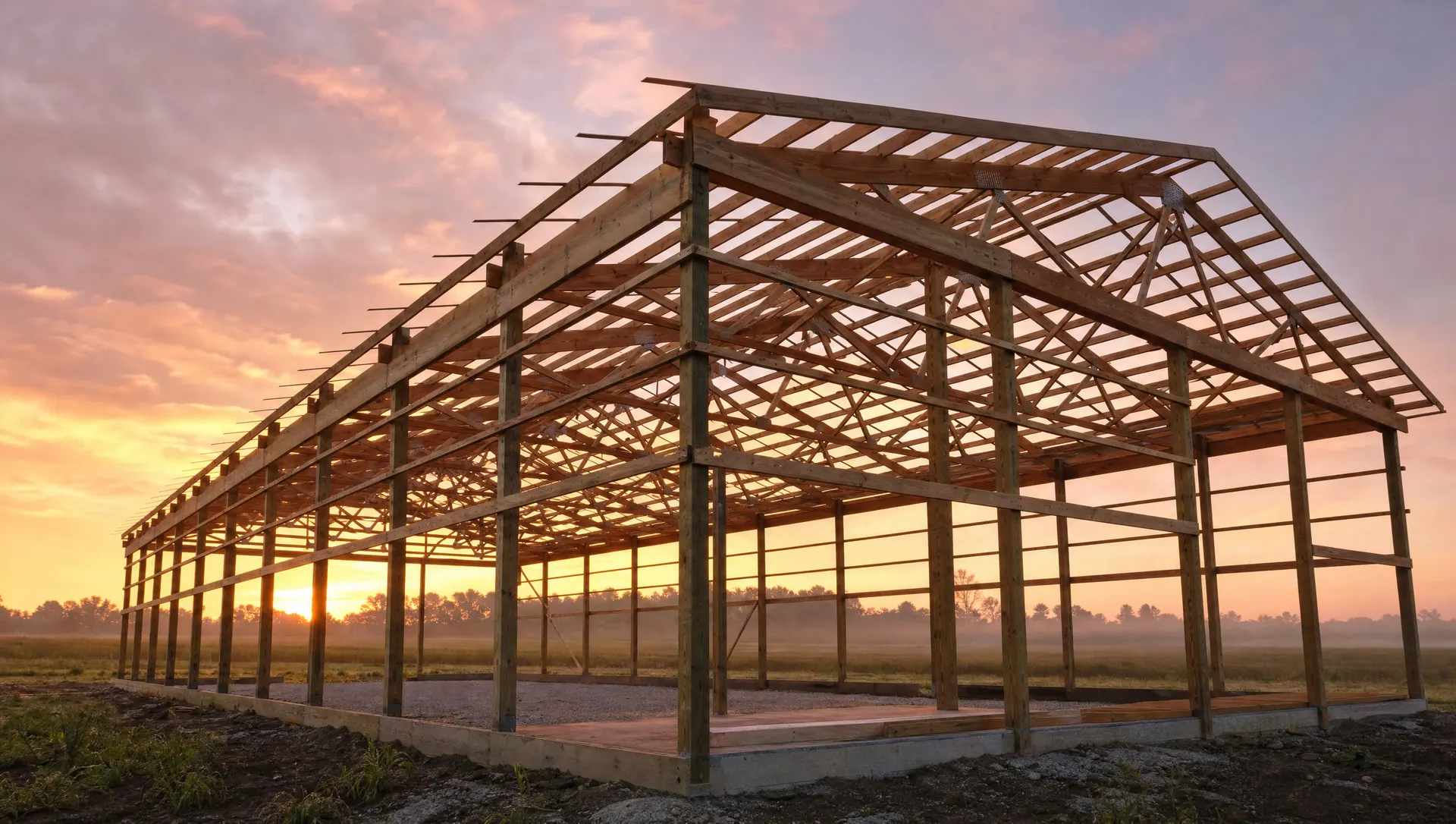
Agricultural Buildings in Boonville, MO
Row crop or cattle, Cooper County farm ground puts real demands on a building. Grain and equipment need to stay dry. Hay needs airflow, not just a roof overhead. Livestock need shelter that doesn't turn into a mud pit every time it rains. Boonville Pole Barns builds agricultural buildings around those specific demands instead of treating a farm building like an oversized backyard shed.
What's Included in an Agricultural Building
Ag buildings get built around function first:
- Equipment sheds with door openings sized for the actual machinery — combines, planters, sprayers, grain trucks — including clearance for attachments and folded booms
- Hay storage with layout and ventilation planned to keep hay dry and reduce spoilage at the base of the stack
- Livestock buildings with open or partially enclosed bays, planned around herd size and how animals move through the space
- Combination buildings that mix equipment bays, a shop area, and storage under one roof, common on working farms consolidating several older buildings into one
Concrete, electrical, and water access get added where the building's use calls for it — a shop bay usually wants concrete and power; an open hay bay usually needs neither.
Built for How Cooper County Farms Actually Work
Farm equipment has gotten bigger across the board, and a lot of the ag building calls we get start with a shed that was sized for equipment two owners ago. A combine head that used to clear an old shed door doesn't anymore. A grain cart that used to fit alongside a tractor now needs its own bay. We size door openings and bay widths around what you're actually running today, plus a little room for what farm equipment tends to do over time — get bigger, not smaller.
Cooper County's mix of river-bottom and upland ground also plays into site planning. Bottom ground near the Missouri River and rolling upland ground behave differently for drainage, access, and how a pad needs to be built up before posts go in — that gets accounted for on-site, not assumed from a satellite photo.
Material choices matter more in an ag setting than in a typical shop, too. Buildings around livestock deal with manure, moisture, and ammonia that wear on lesser materials faster than a plain storage shed ever would, and grain handling brings its own dust and load considerations. We factor the building's actual use into material specs instead of treating every ag building the same.
Timing a Farm Building Around the Season
Construction timing matters more for farm buildings than almost any other project, since the building often needs to be ready before a specific point in the planting, growing, or harvest calendar. Starting the conversation in the off-season — after harvest or before spring fieldwork ramps up — usually gives the most flexibility on scheduling and the least conflict with the rest of the operation. Waiting until equipment is already sitting outside during harvest with nowhere to go puts real pressure on a timeline that works better with some lead time.
Weather affects farm building construction directly too. Post holes, concrete work, and site grading all depend on ground conditions, and a wet spring or a frozen stretch of January can push a start date regardless of how ready the plans are. We talk through realistic timing as part of planning the project, rather than promising a date that ground conditions or material availability might not support.
When to Call About an Ag Building
Farm building projects tend to come up around a few common situations:
- Newer or bigger equipment doesn't fit in the current shed, or barely fits with no room to work around it
- An old barn or shed has reached the point where repair no longer makes sense
- Hay is losing quality to weather because there's no dedicated dry storage
- A herd or operation is expanding and needs more covered space than the farm currently has
If any of that sounds familiar, it's worth starting the conversation even before you have exact dimensions worked out. Operations planning a multi-year expansion also benefit from an early conversation, since a building's footprint and post layout can sometimes be planned with a future addition in mind rather than boxing in later options.
What Affects the Cost
Agricultural building costs typically scale with total square footage first, then with the specifics: door count and size, wall height (taller for equipment with high clearance needs), whether any part of the building is insulated or has a concrete floor, and how much site work the ground needs before construction starts. A straightforward open equipment shed on level ground typically costs less per square foot than a combination building with a finished shop bay, concrete throughout, and multiple large doors. We build the number around your specific building rather than a generic per-acre or per-stall estimate.
Can one building combine equipment storage and livestock space?
Yes — combination buildings that split space between equipment bays, livestock areas, and sometimes a shop are common, especially for operations consolidating several older buildings into one. Layout just needs to account for how those different uses interact, like keeping equipment traffic away from animal areas.
Do hay barns need to be enclosed?
Not necessarily. A lot of hay storage works well as an open-sided or partially enclosed building — the priority is a roof and airflow to keep moisture off the stack, not a fully sealed structure. Fully enclosing it is an option where wind-driven rain or snow is a bigger concern.
What clearance do I need for equipment with folded attachments?
Tell us the tallest and widest the equipment gets with attachments folded or raised — sprayer booms up, a head off a combine, a cart hitched behind a tractor — and we size the door opening and building height around that measurement with room to spare, not a tight fit.
Get a Free Quote
Tell us what the building needs to hold and where the farm is located, and we'll follow up with a straightforward, free quote.
Planning a Pole Barn in Cooper County?
Tell us what you're building and we'll get back fast with a free, no-pressure quote.